
Background
There is an over-representation of Black and Latinx individuals experiencing substance use disorder (SUD) among the homeless population in Boston, MA. In addition, there has been an increase in overdose deaths in recent years, particularly among Black individuals. Low threshold housing with comprehensive services have emerged as an effective and evidence-based strategy to support individuals living with substance use disorders who are experiencing unsheltered homelessness. As a response to the increasing number of individuals who experience both unsheltered homelessness and SUD, in January 2022, the city of Boston established six low-threshold sites (LTS). The Boston Public Health Commission launched the Boston Pathways project to evaluate this policy with a focus on racial equity. BPHC engaged the Institute for Community Health (ICH) to conduct the equity evaluation.
Objective
LTS offer low-barrier transitional housing and support services, focused on stabilization and permanent housing placement and stabilization. Compared to traditional shelters, LTS have reserved beds and lockers, with no sobriety requirements or curfews. As part of a multi-year mixed-methods program evaluation, this study compares housing outcomes between the LTS and Traditional emergency shelter guests.
Methods
Variables
Data Sources
*A different time-period was used for the comparison group to simulate a counterfactual scenario where the LTS did not exist; **Chronic homelessness = Self-report in the lasts stay of being homeless for at least 12 months over the last 3 years OR bed-stay count in shelters higher or equal to 365 over the last 3 years prior to their last stay.
Analysis
Results
Summary of Findings
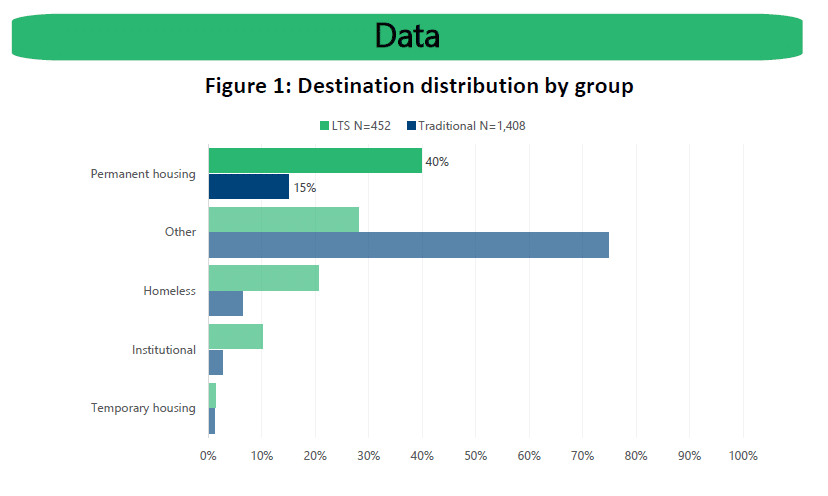
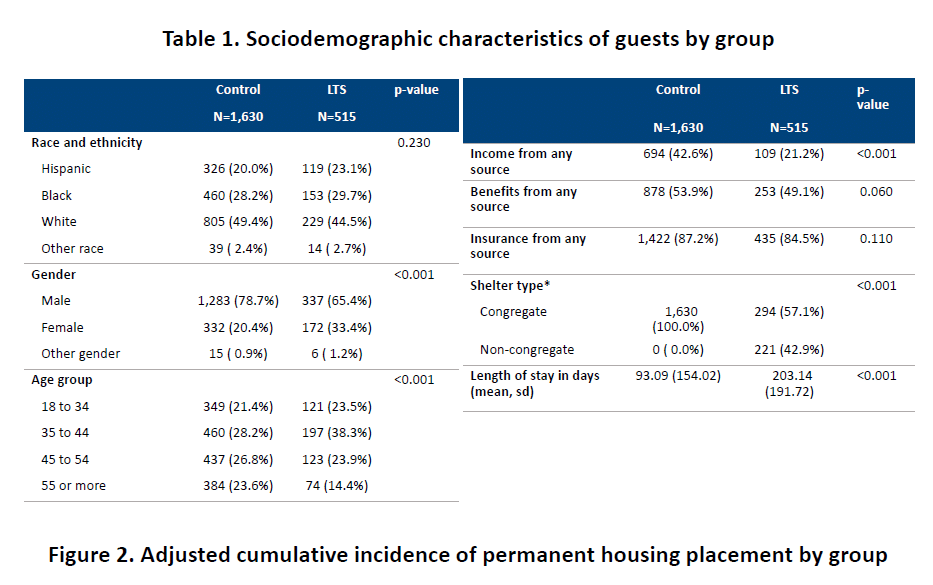
Guests in LTS between January 2022 and December 2024 were placed in permanent housing at 2.2 times the rate as guests in traditional shelters between January 2018 and December 2021, after adjusting for race and ethnicity, gender, age, income and benefits from any source, and type if shelter (SHR 2.21; 95% CI 1.27,3.85) .
Conclusion
These findings, while having limitations, suggest that the LTS is associated with higher rates of permanent housing placement compared to traditional shelters, specifically for chronically unsheltered individuals with SUD. Overall, the results emphasize the importance of policymaking that supports harm reduction and Housing First approaches and low-barrier access in facilitating successful housing transitions.