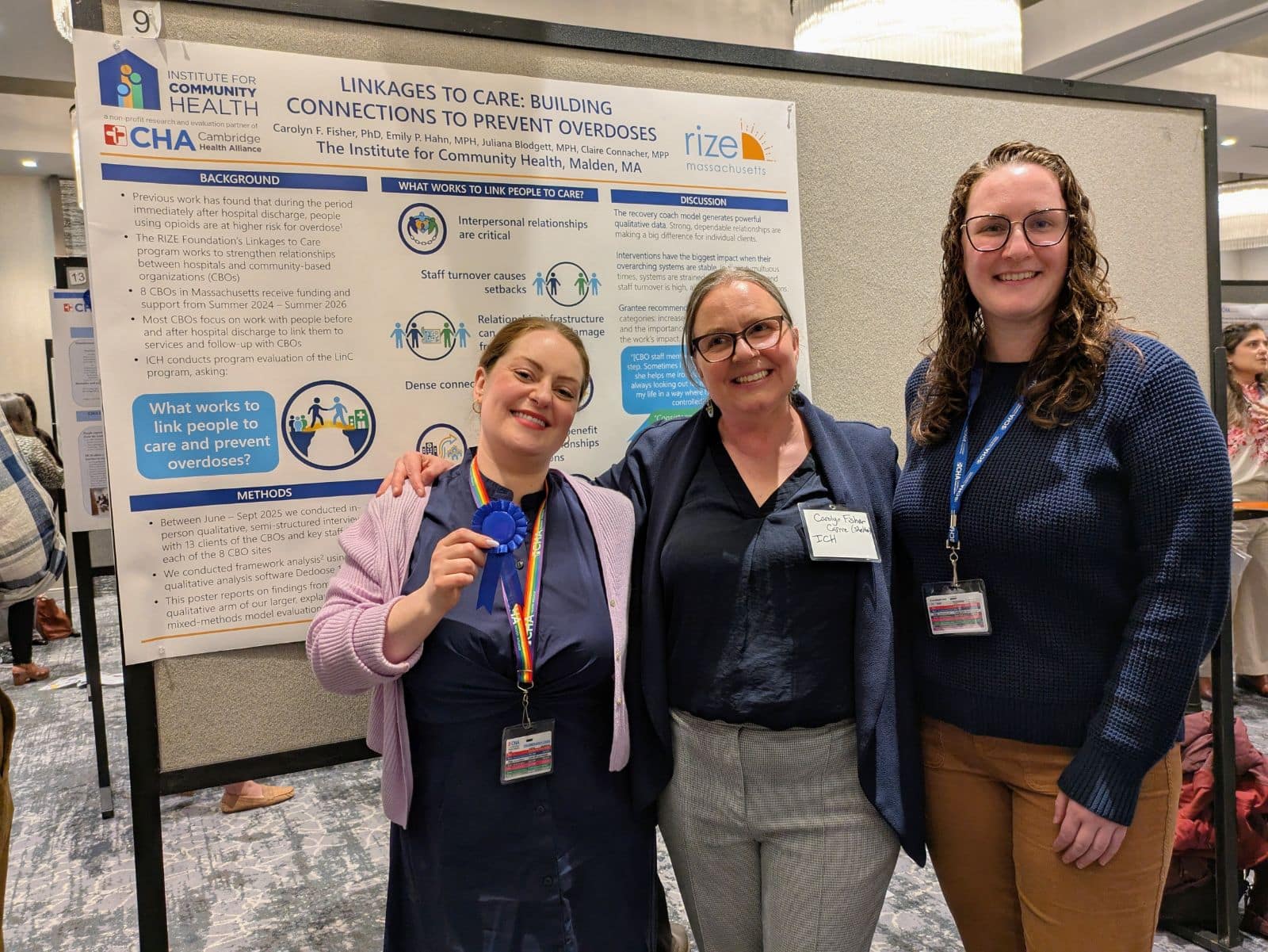
Background: The period immediately following hospital discharge is a critical window of vulnerability to experiencing an overdose for individuals with substance use disorder (SUD). To bridge this gap, the RIZE Massachusetts Foundation established the Linkages to Care (LinC) program, funding eight community-based organizations (CBOs) from Summer 2024 to Summer 2026 to strengthen collaborations with hospital partners and ensure continuity of care during this time window.
Methods: The Institute for Community Health (ICH) is conducting a mixed-methods evaluation of the LinC program using an explanatory mixed-methods model. We report on the qualitative arm of the evaluation here. From June to September 2025, ICH researchers performed eight group interviews with CBO staff and interviews with 13 patients across all grantee sites. Data were analyzed using the Framework Analysis approach to identify themes regarding program impact, relationship building, and systemic challenges.
Findings: Analysis revealed that interpersonal relationships are the cornerstone of successful linkages; trust between CBO staff, hospital personnel, and clients drives engagement. However, high staff turnover in hospital settings presents a significant barrier, often disrupting established referral pathways and causing setbacks to newly-forming ties. While formal infrastructure (e.g., shared tracking sheets and integrated communication lines) can cushion the impact of turnover, it cannot fully replace the efficacy of trusted individual connections.
To build trust, CBO staff emphasize consistency of follow-up and community presence for clients and families. By meeting immediate needs—such as providing food, transportation, phones, or harm reduction supplies—CBOs demonstrate tangible care that can overcome a patient’s mistrust of medical care based on previous negative experiences.
Furthermore, the evaluation found that linkages can have bi-directional impact; CBOs sometimes provide essential stigma-reduction education to hospital staff, while hospitals can offer clinical support to CBOs. Finally, the findings highlight how a hostile political climate has exacerbated patient and provider stress and organizational insecurity, making sustained grant funding vital for maintaining these fragile connection networks.
Conclusion: Overdose prevention can be advanced with a dense network of interpersonal and institutional ties. Forging deep, bi-directional partnerships between clinical and community sectors is helpful to mitigate the risks associated with hospital-to-community transitions in a post-hospitalization period.
By the end of this presentation, participants will be able to: